Web App · 2026
Ekklesia church operating system
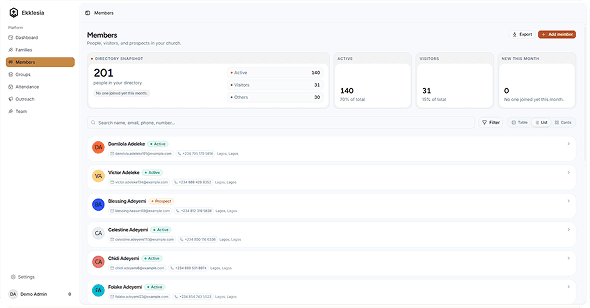
Ekklesia is church operations software for African congregations: membership, groups, attendance, visitor follow-up, and team access in one multi-tenant platform, built to replace the pile of spreadsheets most churches run on.
- Laravel
- Inertia.js
- React
- TypeScript
- Tailwind CSS
- Recharts
Problem
It started narrow: my own church needed a way to track attendance instead of a paper register. But attendance turned out to be the smallest part of what a growing congregation actually needs to run: membership records, groups, visitor follow-up, and who on the team can see or change what. Those were all still living on scattered spreadsheets, so the real problem was operational, not just a missing feature.
Challenge
Attendance had to feel casual in the moment (someone marking a roster during a service shouldn't be fighting a form), but also become a trustworthy record afterward. I solved that by letting rosters stay editable during and right after a service, then locking them once the service is finalized, with an explicit override path for the rare correction. Provisional while it's happening, immutable once it's not, correctable when it has to be: that's a harder balance than either "always editable" or "always locked."
Architecture
Laravel on the backend, Inertia.js bridging to a React and TypeScript frontend, so I get one codebase instead of maintaining a separate API and SPA. Every table (churches, members, services, attendance, groups, follow-ups) is scoped to a church_id, which means the platform was built multi-tenant from day one, even though the first real user was my own church. A dashboard built on Recharts turns raw attendance and membership data into something leadership can actually read at a glance: trends, at-risk members, recent joiners, birthdays.
Decisions
- Multi-tenant from the start (every model scoped by church_id), so the same codebase can serve more than one congregation without a rewrite.
- Attendance locking with an explicit override, instead of either permanently-editable rosters or a hard, no-exceptions lock.
- Visitors get their own pipeline (stage, priority, due dates, an assigned follow-up owner) rather than being folded into the general member list where they'd get lost.
- Dashboard analytics (attendance trends, at-risk members, recent joiners) as a first-class feature, not an afterthought bolted on once data existed.
What went wrong
The attendance and analytics UX needed real iteration, because there was no existing workflow to model it against: I had to design it, watch it fail to fit how a real service actually runs, and adjust. The visitor pipeline is the clearest evidence of that: it didn't exist in the first version. It got added once a flat member list stopped being enough to actually track someone from first visit to follow-up to membership.
Lessons
Good software here is as much about understanding how a church actually operates on a Sunday as it is about writing code. And letting the data model grow only when a real gap shows up (attendance first, then visitors and follow-ups once that gap was obvious) kept the system from being over-built around problems that didn't exist yet.